

21 Aug 2026 · 11 min read · Essay
ARTIFICIAL FUGAZI
Where The AI Cycle Goes From Here

Investing in AI now is precariously difficult. Right now trading AI equities is like treading a minefield - everyone races to the exit at the first signs of negative news. Anthropic ARR’s 2nd Derivative not as good as expected? Nuke the markets 10%. It’s staircase up, elevator down.
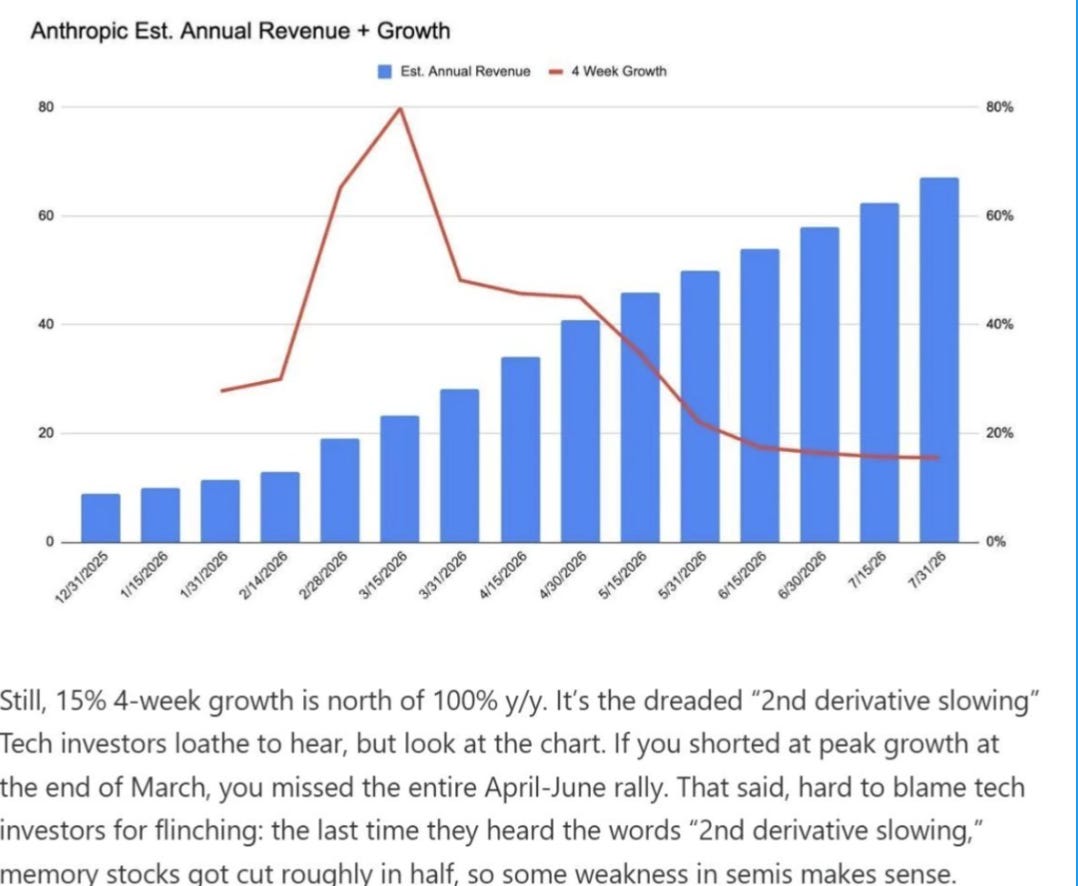
No one really knows what they’re doing. Bulls and bears are fighting tooth and nail over who gets the last say over what. When Nebius released their earnings, the economics of Hyperscalers seemed so strong that a re-rating was imminent. This was of course, followed by an issuance of convertible senior notes ; the end result is that Nebius is up 50% from the Leopold Liquidation Bottom, but down 20% from the highs.
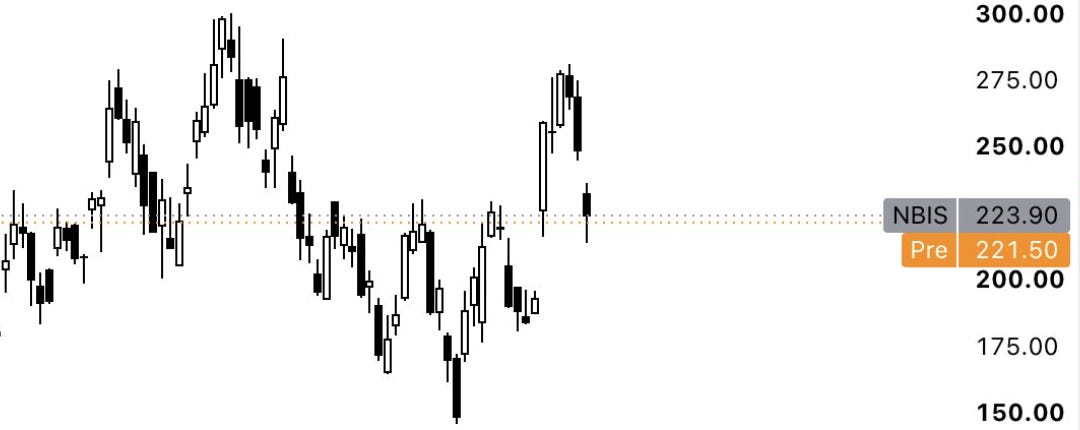
As an investor I have been racking my brain about my stance of AI in the markets today. The conclusion I have been repeatedly saying out loud is that I am "fitting a square peg into a round hole".
Did a lot of reading and thinking re: Where we go from here in the AI cycle over the weekend.
On this website there exists a class of AI substack bros who have become very rich from being right on AI, and thus they have become the default signal for anything AI related. These
Kyle · @zeroxkyle · 2026-08-16 · View on X
I still want to find investments in the AI space, because I think these hot spaces have asymmetric payoff, akin to buying crypto in the bear market of 2022, or tech stocks after the covid-blow up (see Robinhood Chart).
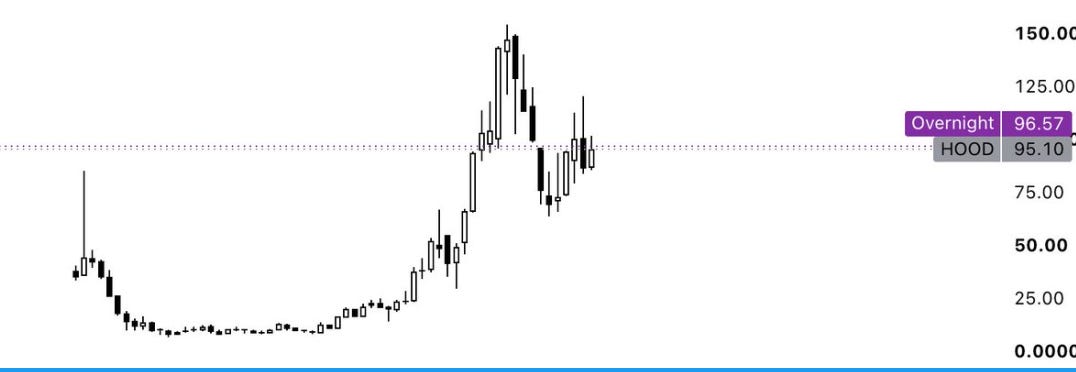
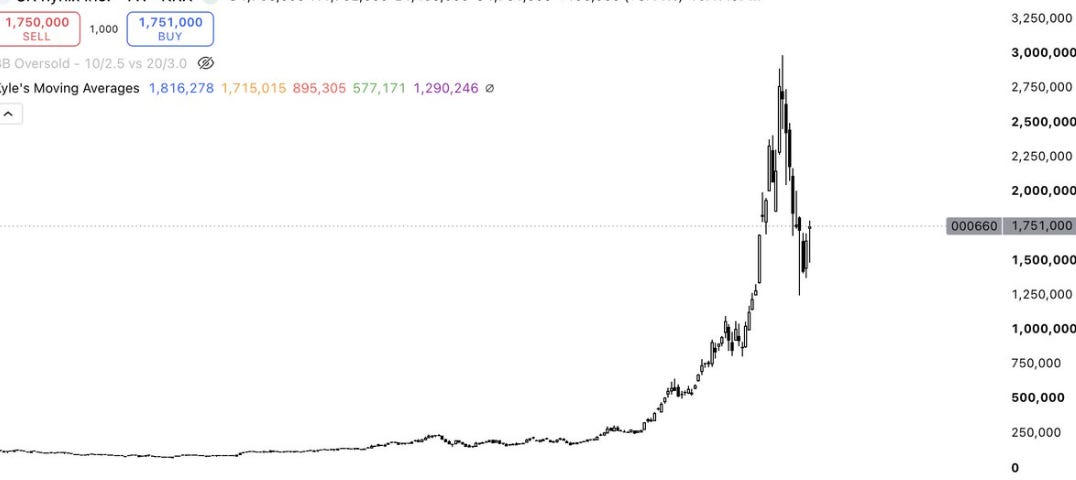
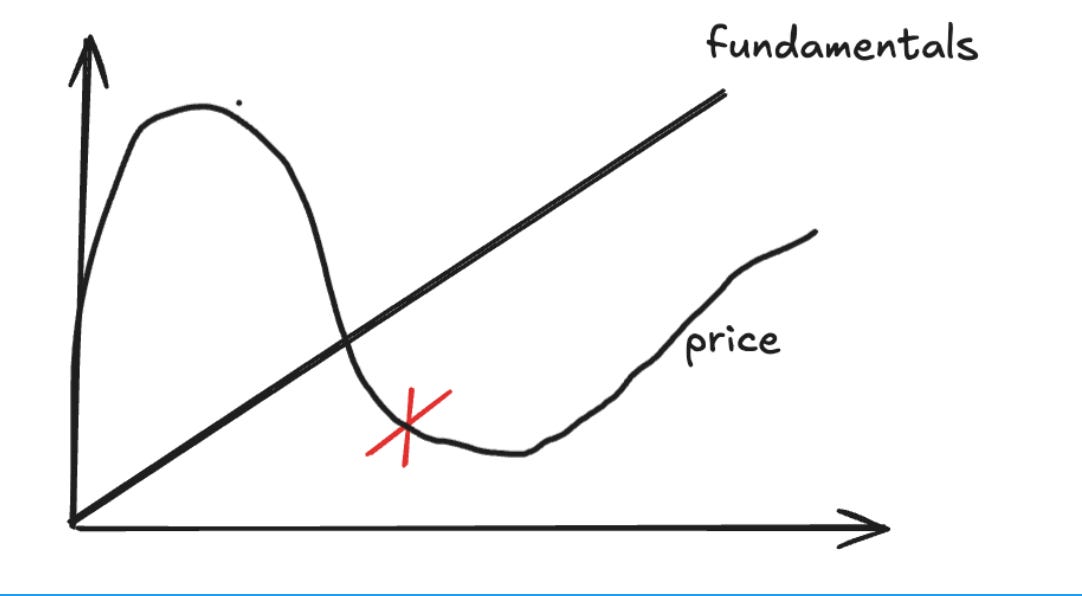
However, other than the fact that I don’t know if the markets will give us a -99% drawdown (I don’t think they will, given how hot AI is), I also think that we need a time-based invalidation instead of price-based this time around (see second chart below).
Hence, my overall view is that “I want to invest in this space, but not RIGHT NOW”.
And so, it’s time to take a step back to re-evaluate my priors to understand what constitutes a good investment in this space. The space has changed greatly, and the timeline of investments was something like:
2022: ChatGPT launched
2024: NVDA as the main beneficiary re-priced
2025: Memory started repricing vertically
2026: Blow-off top and an “everything cycle” - bottlenecks, photonics, optics, anything remotely close to touching the manufacturing space re-priced
2027: ???
I believe that what comes next will be way different than what came before. The essence of the past AI trade is essentially - you don’t know which model will win, but 1 token = 1 token. Whether someone uses Claude, ChatGPT, Grok, or an Open Source model to ask their questions, the energy, infrastructure, compute power, will all be needed. Hence, long infrastructure.
However, I think this approach will not work in the next few years. Let me explain where I think AI is going.
If you enjoyed this, do drop a sub :)
1. AI is highly deflationary. I believe the cost of intelligence continues downtrending. AI does not generate as much earnings as people think they do. In essence, AI is just a tool - a very good tool.
In the worst case scenario, US completely shuts out all models from China. But Pandora’s Box has already been opened - the people know the power of Open Source.
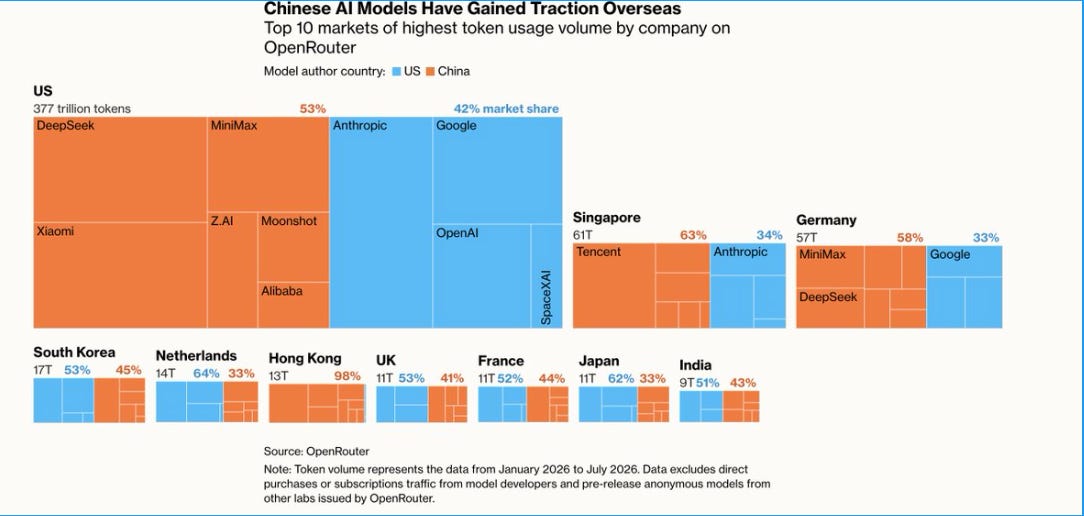
From the Bloomberg Article: “Ben Cera’s start-up Polsia relies on an army of AI agents to automate workflows for businesses. When his platform went viral, his costs went vertical. To save Polsia from potential bankruptcy, he shifted to models by Chinese firms, including Shanghai-based MiniMax.
“At one point I was like, I don’t have a choice,” Cera said from San Francisco. Switching to MiniMax’s M2.7 hosted on US servers for most of his company’s needs cut his AI spending to $100,000 from $1 million in a single month.”
Can you imagine shutting this off? Impossible. It’s like trying to reverse globalisation. It’s done.
On top of that, it’s natural that AI is deflationary. That is the definition of recursive self-improvement (RSI). If something gets better and better over time, it also gets cheaper and cheaper - the same output costs less every year, because each improvement lowers the cost of producing the next one.
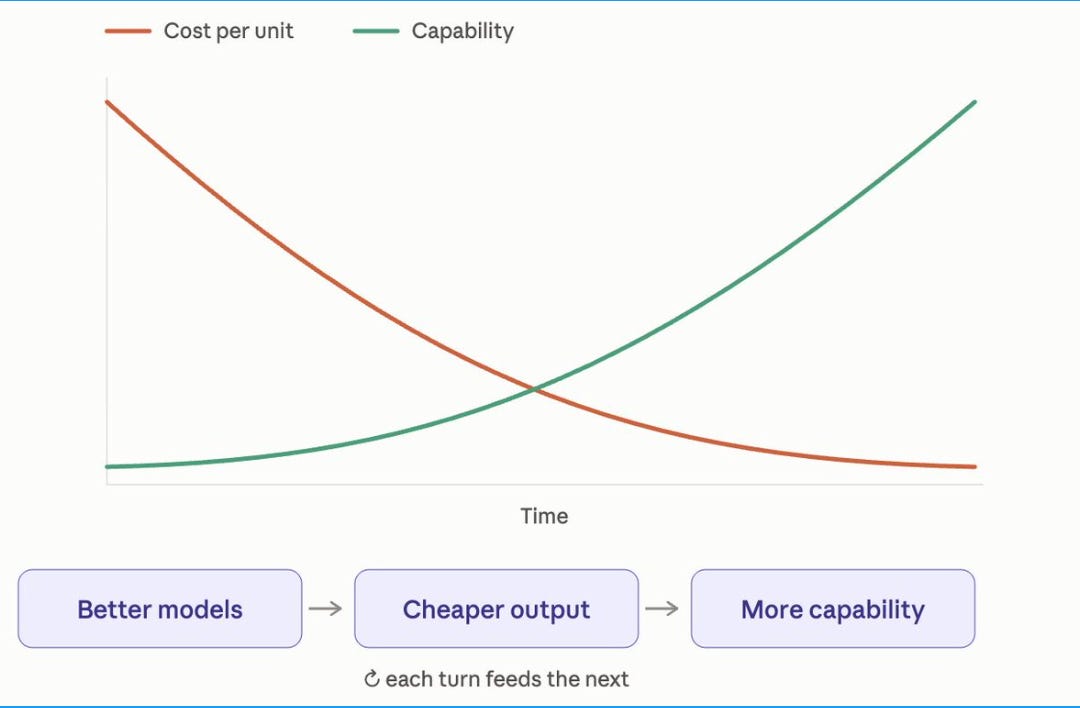
Think about your modern day PC. Last time, computers were huge. Now, you hold the power of a computer that is 1000x stronger than the computers that sent mankind to space, at a fraction of the cost;
This has huge implications. The thing is, today’s models consume enormous amounts of compute because they’re inefficient. No one accounts for this. Google reportedly reduced median AI Overview energy per query by 33× in one year. Coding agents can consume roughly 1,000× the tokens of normal coding interactions, yet different agents solving the same task can vary by as much as 30× in token consumption without higher consumption necessarily producing better results.
Today’s enormous compute requirements partly reflects immature techonlogy. And this immature technology also has immature results - companies are barely reporting improved earnings despite increasing AI spend. And sure, maybe the argument is that productivity gains are hard to spot.
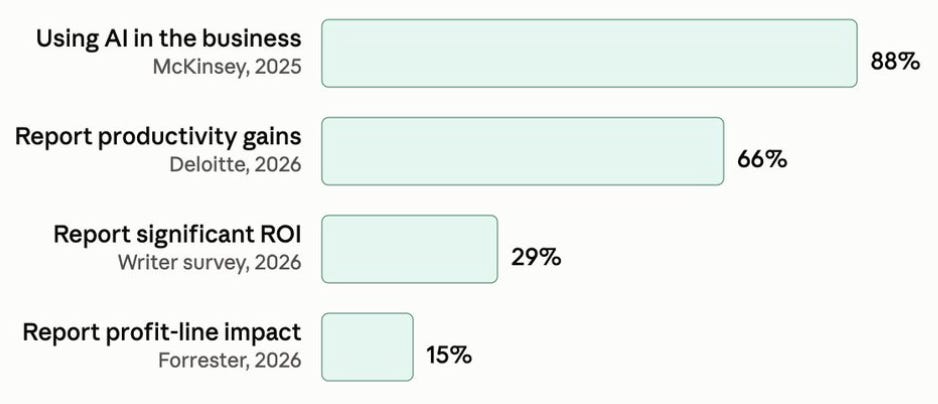
But in such a scenario, the conclusion to draw is pretty simple - just like how Email changed the way communication was handled within a company (but not necessarily increasing $$ output), AI is actually not a top-line story, but a bottom-line story. Using AI doesn’t necessarily increase revenue, but it could potentially decrease costs. And as AI gets cheaper, you just don’t have to spend so much on AI.
Suppose an AI coding agent can initially replace the work of a $250k engineer. You shouldn’t automatically conclude that each agent is permanently worth $250k. Once millions of machine engineers can be produced cheaply, software engineering output itself becomes less scarce, pushing down its economic value. AI doesn’t merely replace expensive human work - it can destroy the scarcity that made that work expensive in the first place.
Not a top-line story, but a bottom line one.
2. What does this mean? But muh COMPUTE, muh MEMORY
Infrastructure always still has a place in the game, and these companies will still make money. However, huge AI demand does not necessarily mean huge returns for AI infrastructure owners from here on out from a markets perspective. There are a few points to consider:
A) For Neoclouds, the bear case is that the cost of these assets depreciate. And I know this is the most cited argument on the net, but look here: both things can be true - assets can have long useful lives, yet their earning power can still decrease.
CoreWeave recently disclosed an A100 contract running through 2029. Bulls took this as evidence that GPUs can remain economically useful for six-plus years. Sure - they can. But likewise, Nvidia’s older V100s are still usable nine years later, but their rental price has collapsed from roughly $3/hour to as little as $0.07–$0.29/hour. So “still generating revenue” is not the same as “still retaining economic value.”
In such a case, the case for Neoclouds and muh compute shortage becomes way lower. Imagine $600–800B of GPUs bought over the previous three years are still working when another $400B of new GPUs arrives. You now have enormous quantities of Hopper, Blackwell, Rubin, Feynman, etc. simultaneously competing to provide compute. Blackwell could therefore remain useful for nine years but rent for only 20% of its original rate by year four.
B) We have already reached AGI. This might not really seem intuitively true, but really, what is the difference for you or I between Claude Fable and Claude Opus? Its ability to one-shot a website was completed 2 iterations ago. Sure, it makes less mistakes. Sure, it can solve more mathematical conjectures. But honestly we reached useful AGI quite a while ago. The 0 to 1 has been crossed.
Ever higher intelligence from here on out may not necessarily translate to higher profits.
3. Basically, my entire view of the AI eco is as such. Things will normalize. And if they normalize, who benefits?
AI can be a technological success (it is!) but the economics may disappoint people. And in such a case, who wins?
Well, this is where we are today. Who wins? The truth is I have no clue. You can go with the obvious answers - “whoever owns distribution”, “we will always need energy”, but those don’t scream asymmetry. Asymmetry to me is a stock that is valued okay-ish now, but is building for a future where they will have a moat, a monopoly, and people depend on them. Like OpenRouter before different AI models really became a thing. They built for the world they saw 3 years from when they started.
My best guess, has to do with Grok Bot. Grok Bot basically gave every agent a computer for them to do work on. This may not seem like a huge deal, but the fact is most agents have been set up on Mac Minis (remember how everyone bought a bunch of PCs for OpenClaw to run on?)
But it would make sense that in the future, companies host entire agentic employees by hosting the PCs themselves. That idea seems intuitive to me - after all, 99% of consumers don’t actually run agents on their PC, and most of my normie friends still use ChatGPT in-app.
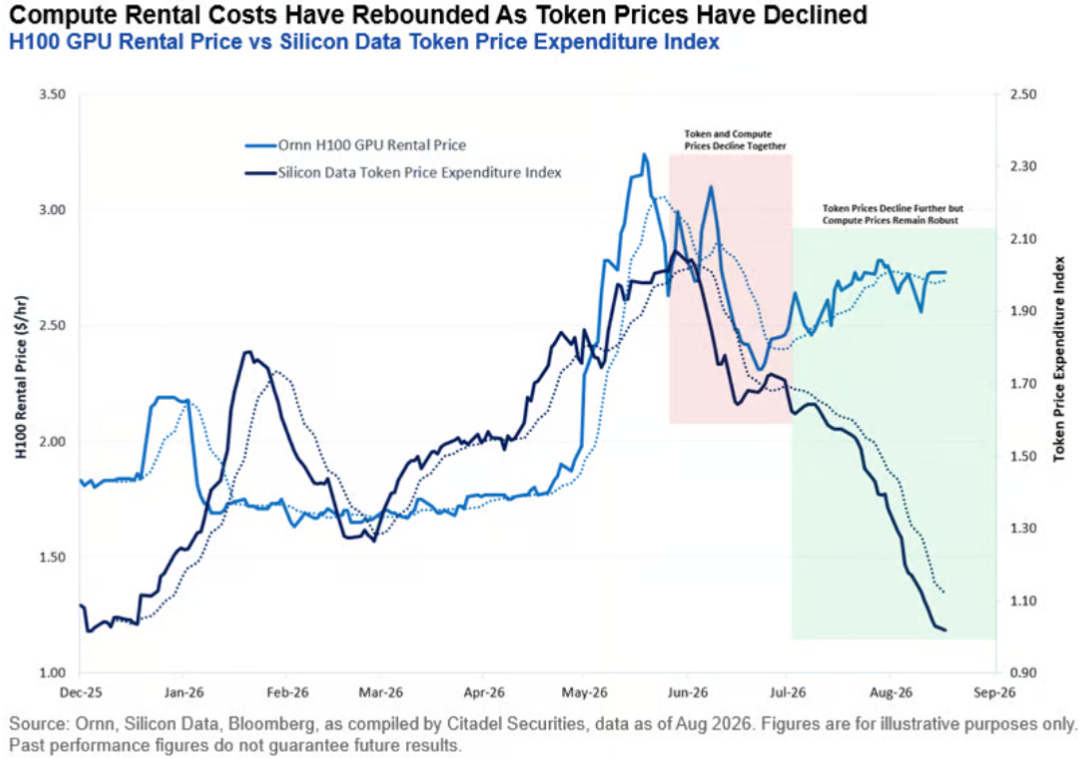
Jevon’s Paradox is on my side too. I expect as token prices collapse, token demand will increase. And as token demand increases, the end state will be multitude of apps to serve these token demands.
Unironically, Software might benefit the most from this. I also have one single stock trade idea that is interesting that I have elaborated to my X subs. But I think, quite frankly, I will go back to the start of my piece - trying to do *anything* right now is putting a square peg into a round hole. Time will tell what happens next.
I hope you enjoyed this!
 Grand Line by 0xKyleAI-powered individual investor writing at the intersection of tech, public markets, and internet culture. Single-stock names, thematic drivers, and the structural trends driving the world today. By kyle
Disclaimer
This content, which contains opinions and/or information related to any products, services, tokens, or projects, is provided for informational purposes only and should not be relied upon in any manner as professional advice, or to be regarded as an endorsement of any products, services, tokens, or projects. There can be no guarantees or assurances that the views expressed here will be applicable for any particular facts or circumstances, and should not be relied upon in any manner. Investments in any products, services, tokens, or projects involve the risk of loss. Past performance is no guarantee of future results. You should always consult your own advisers as to legal, business, tax, and other related matters concerning any investment.
Views expressed are my own
This reflects the personal opinions, viewpoints, and analyses of myself only, and should not be regarded as the views of my employer or its respective affiliates. Commentary on any projects, protocols, companies, or other subject matter discussed in my posts should not be taken or interpreted as an indication that my employer holds any interest in the subject matter discussed. Neither my employer nor myself will be liable for any actions arising from assumptions made with respect to myself or my employer based on my posts.The commentary in any of my posts (including but not limited to those on my blog (
) and social media (
)
Views expressed are not investment advice, endorsements, or recommendations
Any opinions expressed herein do not constitute or imply endorsement, sponsorship, or recommendation by me. I may invest in any of the projects, protocols, companies, or other subject matter discussed without obligations to inform or disclose such investments to you, the reader. The views reflected in the commentary are subject to change at any time without notice.
Nothing on this website constitutes investment advice, performance data, or any recommendation that any particular product, service, token, project, transaction, or investment strategy is suitable for any specific person. It also should not be construed as an offer soliciting the purchase or sale of any product, service, token, or project mentioned. Nor should it be construed as an offer to provide investment advisory services by myself. Any mention of a particular product, service, token, or project and related performance data is not a recommendation to buy or sell that product, service, token, or project.
Statistics are only informative
Any charts provided here or on any of my personal platforms are for informational purposes only and should not be relied upon when making any investment decision. Any indices referenced for comparison are unmanaged and cannot be invested into directly. Any projections, estimates, forecasts, targets, prospects, and/or opinions expressed in these materials are subject to change without notice and may differ or be contrary to opinions expressed by others. Information in charts has been obtained from third-party sources and data. While taken from sources believed to be reliable, I have not independently verified such information and make no representations about the enduring accuracy of the information or its appropriateness for a given situation. In addition, posts may include third-party advertisements; I make no representations of having reviewed such advertisements and do not endorse any advertising content contained therein. All content speaks only as of the date indicated. The information provided here (including any information that may be accessed through this website) is not directed at any investor or category of investors and is provided solely as general information.
Advertisements
I may receive payment from various entities for advertisements on my blog or social media from time to time. Inclusion of such advertisements does not constitute or imply endorsement, sponsorship, or recommendation thereof, or any affiliation therewith by me. In addition, any mention of a particular product, service, token, or project and related performance data is not a recommendation to buy or sell that product, service, token, or project.
I DO NOT WARRANT, ENDORSE, GUARANTEE, OR ASSUME RESPONSIBILITY FOR ANY PRODUCT OR SERVICE ADVERTISED OR OFFERED BY A THIRD-PARTY WEBSITE, AND I WILL NOT BE A PARTY TO OR IN ANY WAY MONITOR ANY TRANSACTION BETWEEN YOU AND THIRD-PARTY PROVIDERS OF PRODUCTS OR SERVICES. I SHALL NOT BE LIABLE FOR ANY DAMAGES OR COSTS OF ANY TYPE ARISING OUT OF OR IN ANY WAY CONNECTED WITH YOUR USE OF THE SERVICES OF ANY BROKERAGE COMPANY.
As always, please remember investing involves risk and possible loss of principal capital; please seek advice from a licensed professional.